No account
Check a filing
Cases, statutes, rules and links, against the record. Inspect the result and download your record.
Check a filing for freeNo card or call needed.
Loupe is a legal citation checker for U.S. court filings. It checks citations against the published record: cases, statutes, regulations and links. It doesn’t generate. It looks up the record.
No account, card or call needed for the free check.
The record: more than 18 million citations to American case law, the page ranges of nearly 7 million opinions, and over 100 courts’ own sites, read every day. What Loupe holds.
Everything else is free too while Loupe is in testing: quotation checks, matters, colleagues, sealed records. Sign in with your email.
loupe.legal
Every citation in your filing,
checked against the source.
Every citation marked in the margin. For each finding, the filing set against the record, and what to do.
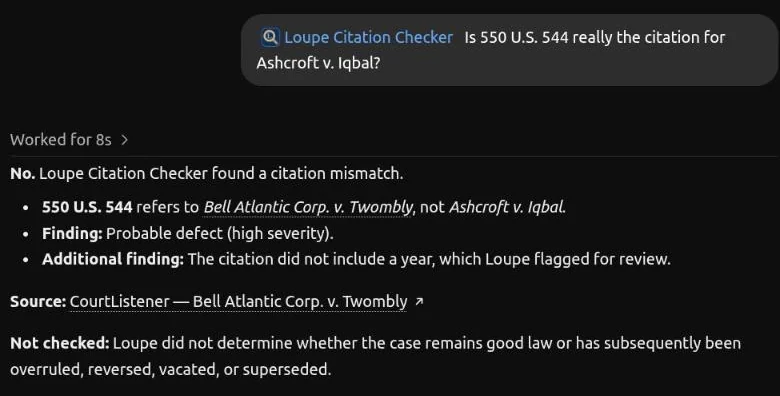
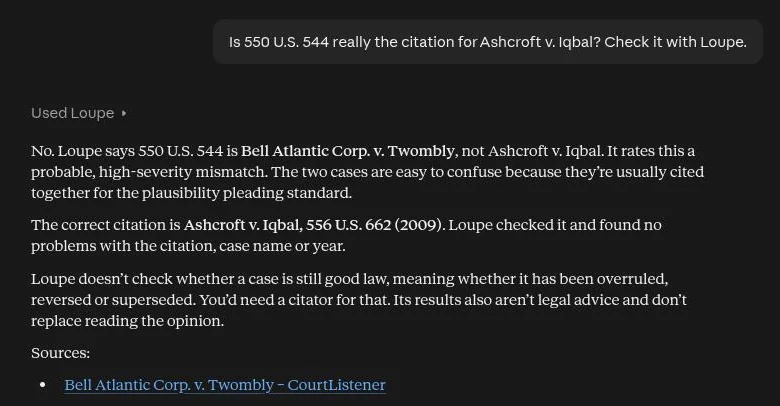
Loupe is in Claude and in ChatGPT. Ask either to check what it drafts, and it sends the text to Loupe: each citation to Loupe’s index, each quotation to the opinion’s own words.
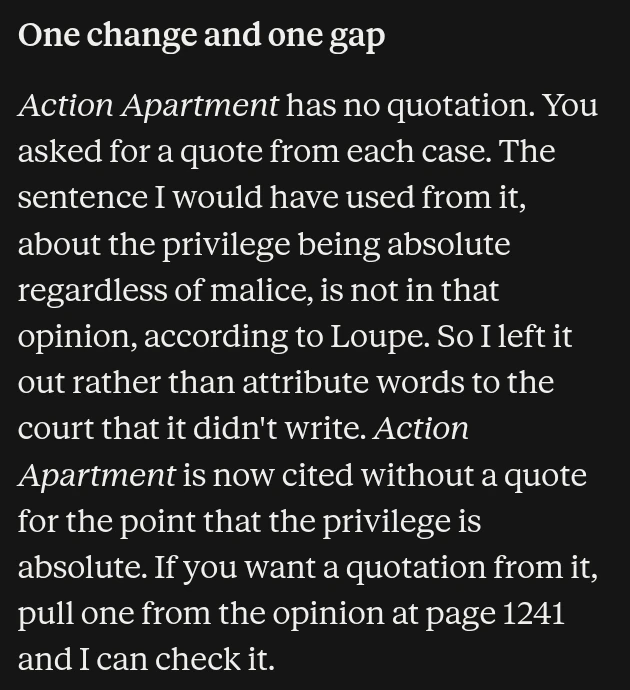
Claude’s draft, quoting Action Apartment Assn. v. City of Santa Monica (2007) 41 Cal.4th 1232
“the privilege is absolute; it applies, if at all, regardless whether the communication was made with malice or the intent to harm”
The opinion, at page 1241
“This privilege is absolute in nature, applying ‘to all publications, irrespective of their maliciousness.’”
Loupe answered “absent”: the words are not in the opinion, which it read in full. Claude took the quotation out and told the lawyer why.
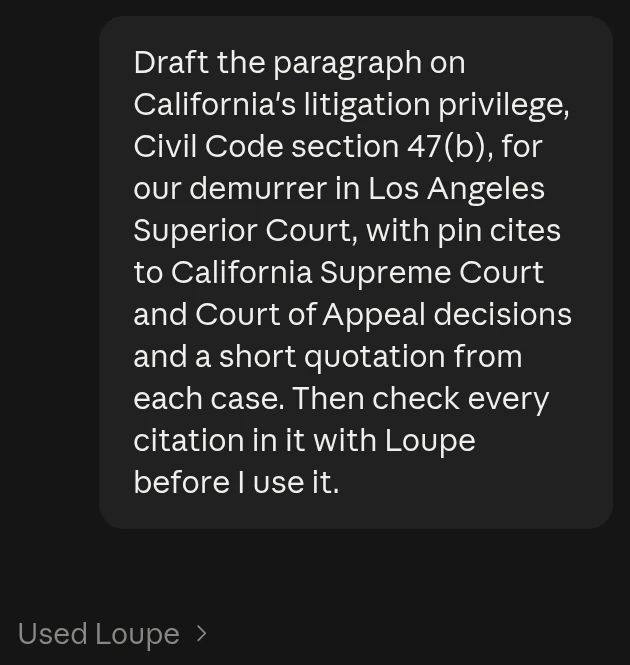
Loupe matched the paragraph’s four case citations and its other three quotations to their sources. It was one of two drafts we asked Claude for that day; the other came back clean.
In Claude’s Connectors Directory and in ChatGPT’s plugins, as Loupe Citation Checker. Free while Loupe is in testing; a quotation check, like this one, asks you to sign in.
In ChatGPT
In Claude
| What is checked | Against | Who | |
|---|---|---|---|
| Cases | The case exists and is the one named, with its year and court, and the page cited falls inside the opinion | Loupe's citation index, and the reporters' page ranges from Harvard's archive | Anyone |
| Quotations | The quoted words are the opinion's own | The opinion's text, and its printed page | Signed in |
| Statutes | The section exists in the current Code | GovInfo, the House’s U.S. Code | Anyone |
| Regulations | The section, in the current Code of Federal Regulations | eCFR | Anyone |
| Court rules | Federal rules, and the states whose rules Loupe can read | The rules as published | Anyone |
| Links | Still reachable, moved, or only in an archive | The live page, the Internet Archive | Anyone |
| Not checked | Whether a case is still good law, and whether it supports your point | A citator's work, and your own reading |
Citations by court system. The darker part carries the opinion's page range, so a pin cite to it can be checked to the page.
Keep each check under its matter. Colleagues and co-counsel read the same citations, ask each other, and the history records who did what.
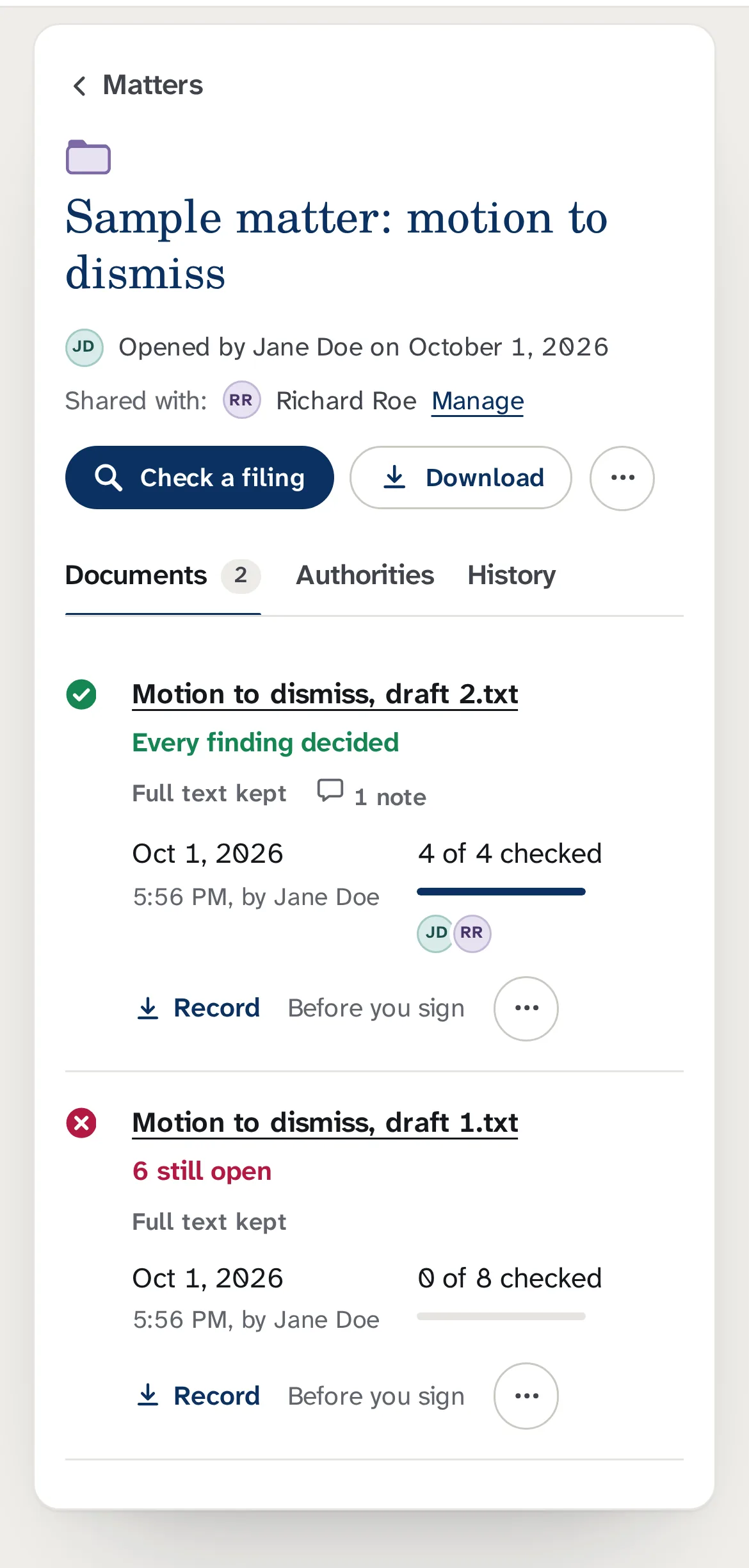
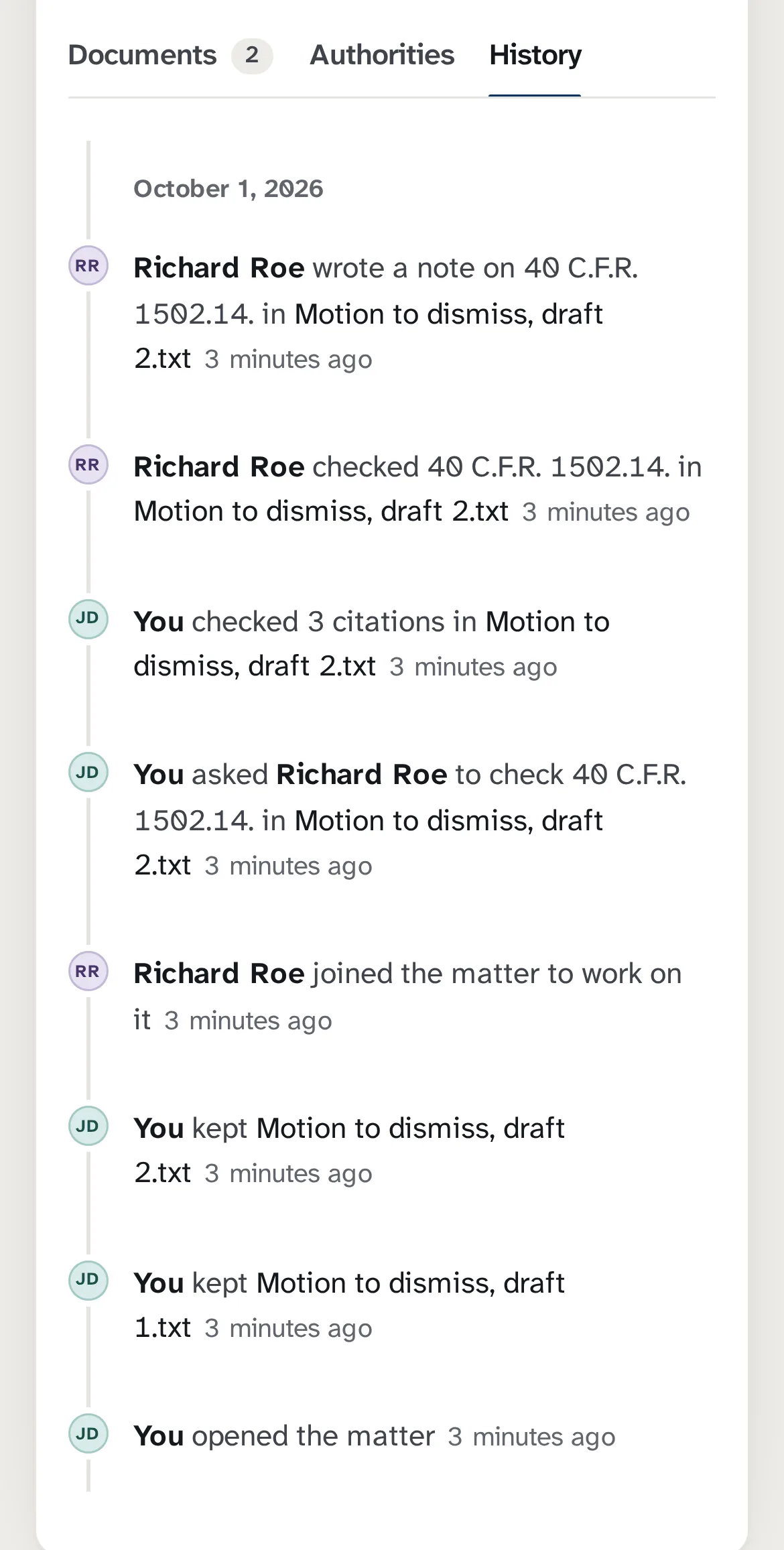
The history writes itself: who kept which draft, who was asked, who read which citation, and when.
Co-counsel from another firm sees this matter only.
Where your court has an order on AI or on checking citations, pick it in the report: it shows what the order asks and drafts the sentence, for you to sign.
A sample matter. The names are placeholders; the checks are real.
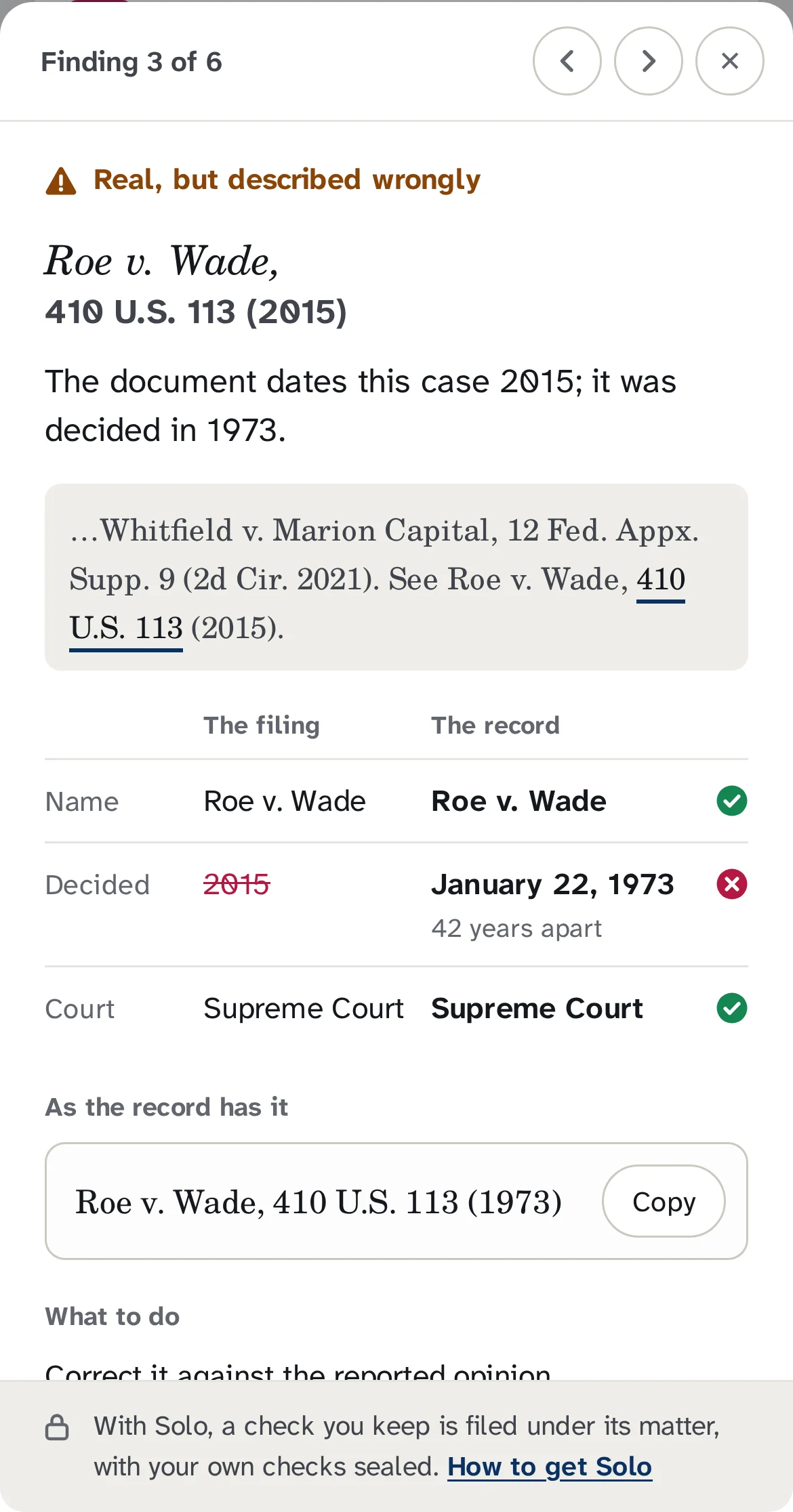
Paste the filing into Loupe at loupe.legal. Every citation is looked up against published case law and the report says whether the case exists and whether it is the case the document names. This is free and needs no account. The harder failure is a citation that is real but carries a different case than the one named, which a lookup that only asks 'does this page exist' reports as fine.
Fabricated authority takes several shapes and they are not equally easy to catch: a reporter that has never been published, a real page carrying a different case, a pin cite past the end of the opinion, a quotation that is not in the text, and a case cited for the opposite of what it held. Loupe checks the first four and says plainly when it cannot check something, rather than reporting it as clean.
Loupe is free without an account for every check its own data can answer, which includes whether each case exists, whether it is the case you named, whether the pin cite falls inside the opinion, and whether statutes, regulations and court rules are real. Its accuracy figures are published together with the document sets they were measured on.
Courts sanction it, and the sanctions are rising. In Couvrette v. Wisnovsky a federal court in Oregon ordered two lawyers to pay a combined $110,204, most of it the other side's legal fees, over briefs citing 15 cases that do not exist and 8 invented quotations. In April 2026 the Nebraska Supreme Court suspended an Omaha attorney, until further order, over a brief in which, by opposing counsel's count, 57 of 63 citations had some sort of problem. A growing number of federal judges require lawyers to certify that the citations in a filing were checked.
Most of these orders ask the lawyer who signs to certify, in the filing, that the citations were checked, or to disclose the use of AI. Loupe has read 45 of them: pick your court in the report, and it shows what the order asks and drafts the sentence in its words, for you to sign. What makes the sentence true is the check before you sign: every authority looked up, and the ones you read yourself.
Only in part. A citation like 2023 WL 1234567 names a document that only the paid database holds, so Loupe never says one does not exist. It reads the number against the names courts give it in their own published citations: where courts in two or more cases call it what the filing does, it holds up; where they call it a different case altogether, Loupe says so and asks you to open it; otherwise it is reported as not verified. Loupe also points to the rule that already requires counsel to file a copy of an unpublished opinion they rely on.